|
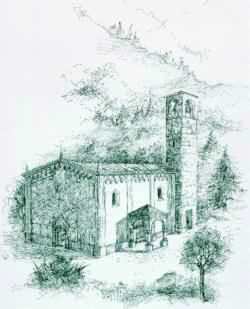
La chiesa sorse nella seconda metà del XV secolo in contrada della Longa, fuori dal paese, ai margini della via Antica Valeriana, l'allora unica via di comunicazione con la valle.
Fu voluta dagli abitanti di Pisogne, e la proprietà da parte del Comune è attestata dallo stemma (la torre) con le lettere V.P. (Vicinia Pisonearum) scolpito nel capitello di una lesena all'interno.
Il monogramma bernardiniano del nome di Gesù, rappresentato in un tondo al centro dell'architrave del portale, e il Trionfo della Morte, ormai scomparso, dipinto ad affresco nella fascia inferiore della facciata, fanno supporre che la chiesa fosse sede di una Confraternita di Flagellanti o Disciplini, che faceva della penitenza e della meditazione sulla passione e morte di Cristo una regola di vita.
La struttura architettonica risponde allo schema delle chiese tardo quattrocentesche della provincia lombarda, a una sola navata, con volte a crociera che uniscono elementi romanici, gotici e rinascimentali.
Originariamente, secondo quanto emerso nel corso degli ultimi restauri, la costruzione si presentava con il piccolo sacello aperto sul lato nord ed una porta preceduta da protiro sul lato sud.
Nella prima metà del XVI secolo la chiesa fu affiancata da due porticati di cui non rimane traccia sul lato nord, mentre quello sul lato sud fu trasformato in cappella del convento dei frati Agostiniani, insediatisi a Pisogne nel 1588 per volere di San Carlo Borromeo.
|
|
The church was built in the second half of the 15th century in the Contrada della Longa, outside the village near the Via Antica Valeriana, that was at that time the only road leading into the valley.
The church was decided upon by the inhabitants of Pisogne whose ownership is proved by the initials VP (Vicinia Pisonearum) found on the emblem (the tower) carved on a pilaster column head inside the church.
The monogram of the name of Jesus, represented in a tondo at the centre of the doorway's architrave, and the now disappeared Triumph of Death, frescoed on the lower part of the façade, make one think that the church was once the home of a Brotherhood of Flagellants or Disciplinarians, whose life was dedicated to penitence and meditation on the passion and death of Christ.
The architectural style is that of the late 15th century churches in Lombardy: one nave and cross vaulted ceilings featuring Roman, Gothic and Renaissance elements.
According to what was discovered during the latest restoration, the building had a small open chapel on the north side and a door preceeded by a short passageway on the south side.
In the first half of the 16th century the church was flanked either side by two arcades. Of the one on the north side there are no remaining traces, while the other became the chapel of the Augustinian monks' monastery, who were established in Pisogne by the order of San Carlo Borromeo in 1588.
|
IL CONVENTO DEI FRATI AGOSTINIANI
oggi Casa di Riposo
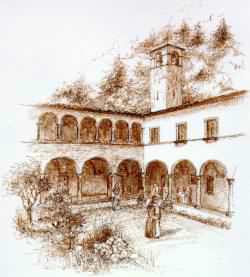
Fu costruito a sud della Chiesa di Santa Maria della Neve, dai frati Agostiniani insediatisi a Pisogne per volere di San Carlo Borromeo nel 1588.
Nel 1789 il Governo della Repubblica Veneta soppresse il convento e vendette l'edificio alla famiglia Mercanti, che, a sua volta, lo cedette alla Vicinia.
Decaduta questa istituzione, passò al Comune che ne fece donazione alla Congregazione di Carità per farne la sede dell'Ospedale (1880), oggi trasformato in Casa di Riposo.
Nonostante le alterazioni e i corpi aggiunti, la struttura dell'antico edificio è ancora riconoscibile: si sviluppa tutta sul lato orientale su due piani. Al pianterreno un portico a cinque arcate dava sul giardino e fungeva da chiostro.
THE AUGUSTINIAN MONASTERY
today The Old People's Home
It was built on the south side of the Santa Maria della Neve church, by the Augustinian monks who settled in Pisogne by the decision of St. Carlo Borromeo in 1588.
In 1789 the government of the Venetian Republic closed the monastery and sold the building to the Mercanti family, who in their turn sold it to the Vicinia. After the decline of the Vicinia, the building was taken over by the Town Council that donated it to a charity organisation for the purpose of a hospital (1880). Today it is an old people's home.
In spite of the alterations and the added parts, the ancient building to the east side with its two floors is still recognisable.
On the ground floor an arcade resembling a cloister looked out onto the garden
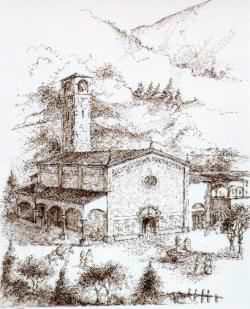
La semplice facciata a capanna è dotata di un elegante portale in pietra rossa di Gorzone , con rilievi a candelabra di gusto rinascimentale; sull'architrave, oltre al monogramma del nome di Gesù, spiccano due tondi con profili di santi. Il portale è opera dello stesso autore che produsse quello di Santa Maria in Silvis.
La ricca decorazione ad affresco, ormai poco leggibile o addirittura scomparsa, copriva tutto l'esterno: sotto gli archetti pensili sono ancora visibili ritratti a mezzo busto di profeti ed antenati di Cristo, testine di cherubini, l'immagine di Dio Padre ed una Vergine con Bambino vivacemente proteso verso l'esterno, appoggiati alla cornice dell'oculo centrale.
The simple hut-like façade has an elegant portal in red Gorzone stone, with church candle reliefs in Renassaisance style; on the architrave, two tondos with profiles of saints stand out, as well as the monogram of the name of Jesus. The portal was the work of the same artist who produced that of Santa Maria in Silvis.
The rich frescoed decoration, now barely legible or completely disappeared, covered all of the exterior: under the suspended arches are still visible bust portraits of prophets and ancestors of Christ, Cherub heads, an image of God the Father. A Virgin with Baby leaning outwards, is just above the circular window.
|
|

|
Interno
LA CAPPELLA SISTINA DEI POVERI.
L'interno è ad una navata ampia di tre campate, divisa in archi traversi acuti, coperta da volte a crociera oblunghe, e riceve luce unicamente dall'occhio circolare posto in facciata.
Le quattro finestre che originariamente si trovavano sulle pareti laterali furono chiuse quando il Romanino eseguì i suoi affreschi.
Girolamo Romani, il Romanino, pittore bresciano, fu chiamato ad affrescare la chiesa nel 1534, su commissione dei Disciplini. I Disciplini stessi suggerirono il soggetto del ciclo ispirato alla Passione, Morte e Resurrezione di Cristo. Le varie sequenze della storia fanno da corollario al tema centrale della crocefissione, secondo una riforma figurativa che, sostituendo le antiche immagini votive unicamente oggetto di venerazione, doveva promuovere religiosità attraverso la meditazione guidata da un predicatore.
La volta è organizzata da una finta struttura a cielo aperto che accoglie figure di Sibille e Profeti in atteggiamenti movimentati che si sporgono e si volgono quasi a colloquiare con lo spettatore.
Romanino, reduce dal lavoro nel Magno Palazzo del cardinale e principe vescovo di Trento, Bernardo Clesio, qui in provincia, lontano dagli umori colti e raffinati delle corti cittadine, poté liberamente esprimersi creando un suo linguaggio originale, anticlassico e fortemente espressivo.
In seguito ai recenti restauri è stato accertato che, prima dell'intervento romaniniano l'interno era adorno di affreschi quattrocenteschi di carattere votivo: ne restano alcuni brani nella volta del presbiterio che conserva inoltre le sinopie che Romanino eseguì senza poi terminare il lavoro, pare, per motivi economici.
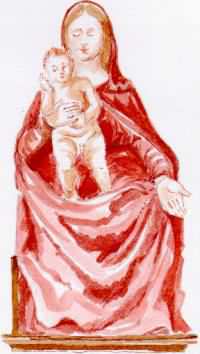
Nell'abside era collocata una statua in legno policromo della Madonna in trono col Bambino Gesù ritto in piedi e benedicente, opera del XVI secolo, di cui restano solo documenti fotografici, perché rubata nel 1971.
Nel pavimento di fronte alla porta d'ingresso una lapide in marmo, con ricco stemma inciso, segna il sepolcro di alcuni membri della famiglia di origine del famigerato bandito pisognese Giorgio Vicario.
Interior:
THE SISTINE CHAPEL OF THE POOR
The interior is one large nave spanned by three pointed arches with a ceiling of cross oblong vaults only receiving light from the circular window positioned on the façade. The four windows originally found on the side walls were covered when Romanino made his frescos.
Girolamo Romani, called the Romanino, a Brescian painter, was commissioned by the Disciplinarians to paint the whole church with frescos in 1534.
The Disciplinarians suggested the subject of the cycle, inspired by the suffering, the death and the resurrection of Christ.
The sequences of the story make inferences to the main theme, the Crucifixion, according to a figurative reform intended to promote religious belief through meditation guided by a preacher, instead of presenting votive images as objects of veneration.
On the vault is painted a sky, crowded with Sybils and Prophets in animated postures, leaning outwards as if almost talking to the onlooker.
Romanino, after having worked in the Magno Palazzo of the Cardinal and Prince Bernardo Clesio, Bishop of Trento, here in the province, far from sophisticated humour and the refined ways of town courts, could freely express himself creating an original style, anticlassical and deeply impressive.
Following the recent restoration, it has been proved that, before Romanino's intervention, the interior was adorned by votive frescos from the 15th century: a few fragments of those frescos are still visible on the vault of the presbytery, which also bears some sketches Romanino carried out without then finishing the work, it seems for economic reasons.
In the apse stood a coloured wooden statue superbly made in the 16th century, representing a throned Virgin Mary with Baby standing on her lap and imparting Benedictions. Due to a robbery in 1971 the only remaining evidences of the statue are photographs.
On the floor near the entrance lies a marble tombstone richly decorated with an engraved emblem, marking the grave of some family members of the infamous bandit Giorgio Vicario.
|
|
LA SAGRESTIA
Dalla porta del lato sud del presbiterio si entra nel campanile e da qui nel vano della sagrestia, che conserva tracce di altri affreschi del Romanino.
La volta era decorata con tenere e vivaci figure di angioletti, ora conservate in Municipio. Sulla parete di fondo un dipinto del XVII secolo attribuito al Voltolino, rappresenta il Magistero della Chiesa.
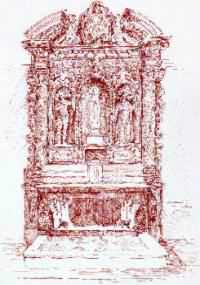
All'epoca del Romanino a questo lato della chiesa era addossato un portico che i frati Agostiniani trasformarono in cappella. L'ambiente, semplice, è dotato di un altare dalla ricca soasa in stucco di fattura seicentesca.
THE VESTRY
From the door on the south side of the presbytery one enters the bell tower and
from here the vestry, where fragments of other frescos by Romanino remain.
The vault was decorated with beautiful, life like angel figures, now kept in the town hall. On the back wall is a painting from the 17th century attributed to Voltolino, representing the teachings of the Church.
In the time of Romanino, this side of the church had a portico that the Augustinian monks transformed into a chapel. The simple room had an altar with a stucco "soasa" in 17th century style.
|
|

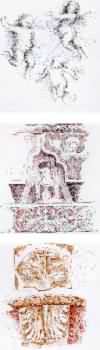
Ai lati del portale due fasce divise in quattro riquadri portavano un Trionfo della Morte, soggetto macabro nato oltralpe e diffusosi, anche se limitatamente, nelle valli alpine. Tale dipinto oggi è completamente perduto, ma ne conosciamo il contenuto grazie ad una serie di disegni eseguiti nel 1846. Sulla fascia di sinistra uno scheletro coronato è in atto di scoccare dardi verso una comitiva di personaggi soprattutto ecclesiastici, che avanzano portando vasi colmi d'oro. A destra lo scheletro è disarmato e invano tende l'arco senza dardi verso i rappresentanti dei vari ceti sociali ed autorità secolari che sono guidati e preceduti da Cristo, Maria e Santi.
Il significato è evidente: davanti alla morte non può nulla nemmeno il denaro, solo in Cristo si può trovare la salvezza.
Il piccolo sacello sul lato nord era anch'esso affrescato sia all'interno che all'esterno.
Oggi restano pochi frammenti di questi dipinti che rappresentano la creazione dell'uomo, all'interno degli archetti pensili che portano all'esterno delicate figure di angioletti musicanti.
All'interno del sacello si possono ancora vedere alcune parti di affreschi votivi. Tutta la decorazione dell'esterno è attribuita al pittore Giovanni Pietro da Cemmo, attivo in Valle Camonica nella seconda metà del '400, ed alla sua cerchia.
La parete laterale della chiesa era adorna, sotto al portico ora scomparso, di un grande affresco cinquecentesco del Romanino che rappresentava il Presepe, completamente perduto, l'adorazione ed il corteo dei Magi di cui restano pochi frammenti strappati nel 1878 e conservati nel presbiterio.
Sempre su questa parete esterna , in seguito alla perdita del Presepe del Romanino, è emerso un riquadro raffigurante la Vergine incoronata , circondata da scenette della vita contadina e lacuale di Pisogne.
To the sides of the doorway two wide strips divided into four panels were showing a Triumph of Death, a French macabre subject of which a few examples can still be found throughout our alpine valleys. The painting is today completely lost, but we know its contents thanks to a series of drawings made in 1846. On the left strip was a crowned skeleton in the act of shooting arrows at a group of ecclesiastical characters, carrying vases full of gold. On the right strip was another skeleton: disarmed and in vain pulling a bow without arrows towards the representatives of the various social classes and secular authorities, guided and preceeded by Christ, Mary and the Saints.
The meaning is evident: facing death even money is worthless, only in Christ can one find salvation.
The small chapel on the north side was also frescoed on both the interior and exterior. Today only few fragments of these paintings, representing the creation of man, remain on the inside.The exterior of the suspended arches shows some graceful angel musician figures.
Inside the small chapel one can still see some parts of votive frescoes, while the external decorations are attributed to the painter Giovanni Pietro of Cemmo and to his school of art, active in Val Camonica in the second half of the 1400s.
The lateral wall of the church was adorned, under what was a portico, by an almost lost 15th century Romanino fresco that represented the Holy Birth and the worship and the cortege of the Magi: the only remaining fragments were removed in 1878 and are now conserved in the Presbytery.
Still on the same external wall, following the loss of Romanino's Holy Birth, emerged a panel representing the crowned Virgin surrounded by sketches of farming and lakeside life in Pisogne.
|
|